
Advocacy for the Yoga Profession
The standard of professional yoga
We work directly with government, health insurers, and adjacent industries to improve conditions for yoga teachers, from fair pay and superannuation through to recognition of yoga as an established health modality. Our advocacy is grounded in credible research, clear professional standards, and ongoing collaboration with stakeholders across the yoga community and beyond.
Through our relationships with Indian institutions and international yoga bodies, and our growing library of professional and academic resources, we are positioning Australian yoga professionals as intrinsic to the global milieu. Our ambition is a profession commanding respect at home and abroad.
Latest Action
13 entries · 2025–2026
-

Jarring Things
The road is less travelled for good reason Yesterday I was chatting to someone about how taking a holiday from work can almost be traumatic. For some people at least, especially if that person is a high achiever or for any other reason they are enjoying the distraction that the workplace offers. Being pulled away…
-

Super Contributions for Yoga Teachers
Note: Laws surrounding the payment of super to contractors in Australia, and workplace relations in general, are complex and the views expressed in this interview are for general information purposes only. A Short History of Super Superannuation is designed to support Australians in building a secure financial future, offering a supplement to the government’s age…
-

Yoga in the Fast Lane
On Friday I sat at the Prime Minister’s lunch for Prime Minister Modi in Melbourne, with leaders from sport, business, and the Indian-Australian community. The occasion was warm, the closing engagement of a visit with big announcements already made, and Prime Minister Modi flew on to New Zealand straight afterwards. Cricket led the day, with…
-
State of Yoga 2026
In 2026 the yoga market is smaller than it was five or ten years ago, and more serious as a result. Private health rebates have returned, the most significant development of the past two years, lifting the standing of senior teachers closer to that of physiotherapists.
-

Yoga Therapy at Yoga Australia
Yoga Australia holds the largest community of yoga therapy qualified professionals in the country, and over the past three years that community has been doing some of the most compelling work anywhere in Australian yoga. The Yoga Therapy Committee, a group of experienced practitioners who volunteer their time and expertise, has built an annual summit…
-

Structural Advantage
The value of a Teacher Training Course is what becomes of its graduates. Someone who finishes and finds opportunity with studios, satisfied insurers, and even Private Health eligibility, spreads the good word about where prospective students ought to train. Another one of the most consequential decisions teachers make should be the selection of their representational…
-
Voluntary Registration and Positive Duty
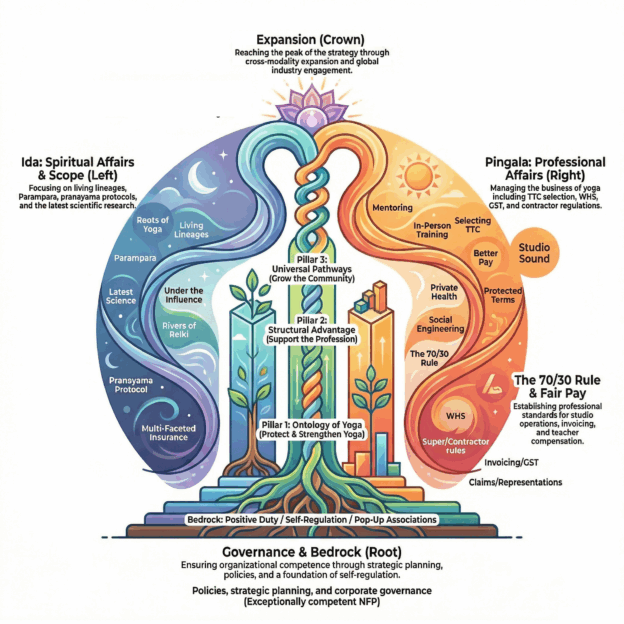
Years ago, Yoga Australia did a great deal of soul searching and arrived at the position that we recommend voluntary registration. The alternative would be governmental control of the profession, with an appointed association placed in charge, compulsory membership, enforced rules, and price increases. Yoga works best when people come to it on their own…
-

Shared Language and Protected Terms
Providers of Teacher Training Courses operate within Australia’s broader education landscape. While our primary focus is on sharing the transformative practice of yoga, the language we use to describe our courses matters a great deal, legally and ethically. This article explains key terminology carrying legal protections in Australia, helping you ensure your course descriptions are…
-

The Hyper Mobile Yogi: Teaching Internationally
If you have ever imagined yourself teaching in India, Greece, or London, you’re in good company. Yoga is a global practice, and qualified Australian teachers are welcomed in studios and retreats all over the world. The path to getting there is less mysterious than it might seem. Getting hired abroad The process of finding work overseas is often similar to your local…
-

Yoga: An Ontological Perspective
What is Yoga? The word “yoga” denotes both the state of nonduality and the collection of practices from India that help us reach it. Unlike passive treatments such as massage or chiropractic care which are performed on you, yoga is an active practice you engage in, sometimes with guidance from a teacher, but ultimately a…
-

Yoga Coverage for Workshops and Retreats
There comes a point in every dedicated teacher’s career when regular classes can no longer contain everything you want to share. Workshops let you go deeper into a subject over a few hours and retreats let you hold space across days. Both are wonderful progressions, and both introduce considerations that a standard studio class simply does not. If you have been…
-

Permission to Believe
A reflection on yoga, colonisation, and the strange fate of living traditions I was in a café in Gokulam, the Mysore neighbourhood that has become a kind of pilgrimage site for Western yoga practitioners owing to TKV Krishnamacharya’s presence in the 20th century. A young Indian man working behind the counter noticed the triśūla tattoos on my arms and…
-

Yoga is Peak Experience: 2025 Wrap Up
Yoga is Peak Experience We don’t need to explain consciousness to someone who’s just tasted it. The experience itself becomes the teaching, the proof, the communication. Yoga is inherently pluralistic, constantly borrowed and reused, yet rooted in something undeniable. This makes it resilient and dangerous to the ego and its status quo. A call to…
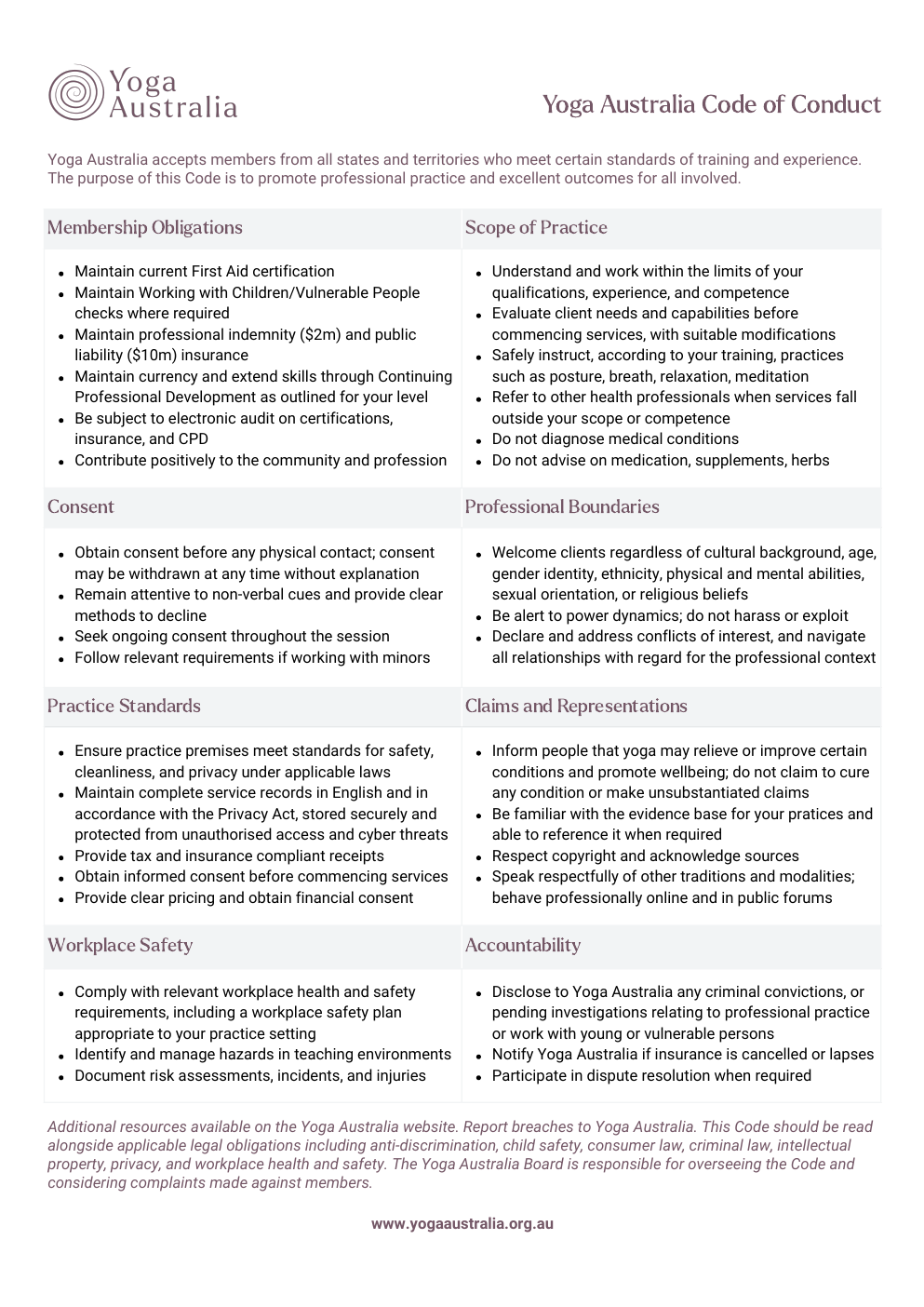
The Code of Professional Conduct
A one-page reference summary of the Code, suitable for studio display and member onboarding.
Yoga Australia’s Guiding Principles
Yogic Precepts
Classical Yogic Precepts
The yama and niyama as outlined in Patañjali’s Yoga Sūtras offer behavioural guidelines for practitioners: ahiṃsā (nonviolence), satya (truthfulness), asteya (non-stealing), brahmacarya (right use of energy), aparigraha (non-grasping), śauca (cleanliness), saṃtoṣa (contentment), tapas (discipline), svādhyāya (self-study), and īśvarapraṇidhāna (surrender to what is greater). These are not moral commandments but practical orientations toward clarity and away from harm.
Yoga’s ethical foundations predate Patañjali. The yama and niyama appear in varied forms across the Upaniṣads, in Śiva and Tantric traditions, in Haṭha texts like the Haṭha Yoga Pradīpikā, and in the oral teachings of living lineages. Each articulates the relationship between conduct and practice differently. Some emphasise renunciation, others integration. Some list five principles, others ten or more.
What endures is the recognition that consciousness shapes conduct. The familiar English translations, nonviolence, truthfulness, contentment, carry centuries of colonial and religious reinterpretation. The deeper inquiry concerns movement away from hiṃsā in all its forms, not only physical violence but the subtler violence of grasping, accumulation, and self-deception. These guidelines support the practitioner in becoming less entangled, more present, less harmful.
Yoga Australia does not prescribe a single ethical framework. We expect members to engage seriously with the traditions they teach and to conduct themselves with integrity, care, and respect.
Organisational Voice
We are here to ignite yoga around the country, to cast a bright light.
Our presence spans articles, magazines, newsletters, social media, podcasts, webinars, and we pursue the highest editorial standard across the suite. We watch the sector, listen across membership, and notice changes in yoga and adjacent modalities. Our messaging is beholden to the enduring application of yoga. We intend to be thoughtful, nuanced, educated, remaining restrained in the surrounding chatter.
Everything published under our name is assessed according to the editorial standards of accuracy, tone, and care. We stay out of party politics, religious debate, and cultural flashpoints. Where public policy touches the profession, such as regulation of training, scope of practice, allied health, academia, and public access, we engage with substance and care. Member scholarship is an aspect of collective voice, and when members publish books or studies that add to public or professional understanding of yoga, we consider features in the form of articles, interviews, and events.
Resharing and engagement
We receive more tags than we could ever reshare, and we rarely do, however well meant. Resharing implies endorsement, and endorsement given by accident is a favouritism we cannot afford. Comments on our own posts are managed lightly. We answer direct questions, correct errors of fact, and otherwise leave the conversation alone. We do not engage in algorithm-enabled furore.
Personal Engagement Online
Yoga Australia benefits when Directors, Staff, Volunteers, and Members are active online, on podcasts, and in other public forums. Engagement of this kind strengthens credibility, deepens relationships across the wider yoga community, and brings more people into contact with thoughtful practice. The reach of social media is limited and somewhat overstated, and even so, a good conversation in the right corner of the internet still counts for something.
The challenge is that the line between personal and institutional speech blurs on these platforms. A Director raising a concern about another teacher’s promotional material may be acting on their own initiative, and an observer can read the comment as Yoga Australia taking a stance. A Staff member commenting on a public dispute, even in their own time, can sit too close to the organisation.
Practical guidance
Make clear when you are speaking personally. A bio line such as “personal account, views my own” helps, although a disclaimer alone does not fully insulate the position. Ask before engaging:
- Could a reader reasonably infer that I am speaking for Yoga Australia? If yes, the matter may be better run through official channels.
- Does the engagement raise the appearance of conflict, advocating for things that benefit my private interests, criticising a peer who competes with me commercially, weighing in on a process Yoga Australia might handle officially? If yes, step back.
- Would I be comfortable seeing this conversation read aloud at a Board meeting or quoted in a member’s email to me? If yes, proceed.
Public criticism of named Members, Training Providers, or organisations is the area to be most careful. A negative public comment about a named party can prejudice a complaint or grievance Yoga Australia might receive, expose the speaker and the organisation to defamation risk, and pre-empt processes better handled privately. If you have a concern about another teacher or provider, raise it with Yoga Australia or relevant authority directly rather than airing it publicly.
You are free to participate in public debate as a private individual, including on social and political issues. The standard to observe is whether your conduct would cause a reasonable observer to doubt your ability, or Yoga Australia’s ability, to act professionally and impartially [ref 1]. Strong, repeated, or vehement positioning on contested matters is the area to watch. Considered engagement with substance, including on matters of public policy that touch yoga, is welcome.
Where doubt arises, talk to the CEO before posting.
Platforms and their effects
Social media is engineered to keep people scrolling. The same algorithms that hold attention on poker machines exist on the platforms hosting these conversations. Heavy use is associated with stronger false consensus effects, an inflated sense of how widely the views one encounters online are shared. Platforms can adjust algorithms to hold attention. Caution is emphasised, and it is wise to keep engagement brief and considered.
Ref 1. This standard is adapted from the Australian Public Service Commission’s social media guidance and the NSW Government’s social media guidance for employees, both of which use a reasonable observer test to govern personal online conduct by people in roles that carry public trust. APSC, Social media: Guidance for Australian Public Service Employees and Agencies. NSW OPSC, Use of social media in a private capacity.
Content Contribution
Yoga Australia’s member experience is built by its people. Volunteers and staff host a full calendar of events in person and online, and members teach, present, write, and appear on podcasts. It behoves those closest to the organisation to be sure of their obligations and rights. Anyone serving Yoga Australia may propose a piece of content, an event, an article, or a mixed media resource, and it is considered on the same basis as any other member’s proposal. Nobody is entitled to run an event, but everyone is welcome to propose one. We vet potential contributors, including a review of their business website for protected qualification titles and for claims that could mislead under the Australian Consumer Law. While norms vary between countries, we aim to apply consistent criteria.
This policy covers material contributed to Yoga Australia for publication, whether an article, interview, webinar, or any mixed media production. It applies whether or not the contribution is paid. Contributing material grants us the right to edit and publish your work, including summarising and reformating across platforms. Our intent is to extend the useful life of quality works across the portal members use. Substantive editing that changes the meaning is discussed with the contributor before publication.
Australian law recognises a contributor’s moral rights, the right to be attributed, the right not to be falsely attributed, and the right to object to derogatory treatment of the work. You are credited in every form your material takes, and we will not present it in a way that misrepresents your intent or harms your reputation. For interviews, webinars, photographs and video, your likeness may be used in the original publication and in reasonable promotion of it, and use in unrelated promotional contexts takes fresh consent. You may request withdrawal of your material on reasonable grounds, such as factual error, changed circumstances, or reputational concern, and we will remove it from active publication within reasonable notice and reasonable effort.
Compensation, where it applies, is agreed by email at the time of contribution, from unpaid through to paid commission. Where Yoga Australia has paid, the rights granted are perpetual within the scope above, and withdrawal on the grounds described remains available, with any refund of compensation handled case by case. Concerns about how contributed material has been used, edited, or attributed go to the CEO in the first instance.
Proposals are made through the form below, read by staff, and considered against our editorial themes and publishing schedule. Declare a commercial interest in what you are proposing, whether a book, a studio, a training, or a product.
Professional Standards
Membership Obligations
Yoga Australia accepts members from all Australian states and territories. Applicants must disclose prior convictions, disciplinary proceedings, or pending complaints relating to their practice. Yoga Australia reserves the right to suspend or expel members in accordance with the Constitution.
Members are required to abide by the Yoga Australia Constitution and this Code of Professional Conduct, meet CPD requirements of 12 points (minimum 20 hours per year for Level 2 and 3), maintain current First Aid qualifications, and hold professional indemnity insurance ($2m) and public liability insurance ($10m). Recommended insurer is GSA Insurance. Yoga Australia does earn a commission from insurance policies taken with GSA, and we recommend you obtain advice and carefully consider the insurance that best meets your needs.
Continuing Professional Development
The yogic path is one of perpetual learning. Continuing Professional Development reflects this commitment, keeping teachers current with evolving practices and evidence while deepening their own understanding. CPD is an opportunity to deliver better outcomes for clients. All members accrue 12 points each year (consisting of 20 hours for Level 2 and 3). Yoga Australia provides CPD Short Courses on the member platform, and members may also complete courses from external providers. Compulsory topics include mental health and cultural awareness. A committed personal practice is assumed.
Professional Conduct
The relationship between teacher and participant carries particular responsibility. In this context, “participant” includes those attending yoga classes, clinical clients, teacher trainees, and those being mentored. Respect means welcoming participants regardless of cultural background, age, gender identity, ethnicity, physical and mental abilities, sexual orientation, or religious beliefs. It means maintaining spaces that are safe, clean, and comfortable. It means listening, communicating honestly, and protecting privacy.
Consent and Physical Contact
Physical adjustments are common in yoga instruction, but they require care. Consent must be obtained before any physical contact, and it may be withdrawn at any time. A participant who declines touch owes no explanation. Teachers should remain attentive to non-verbal cues, provide clear methods to decline, and seek ongoing consent throughout the session.
Professional Boundaries
Context shapes what boundaries are appropriate. A drop-in community class differs from a long-term mentoring relationship or a therapeutic setting. Power dynamics are inherent in professional relationships, and teachers must be alert to them. Behaviour that harasses or exploits participants is unacceptable. Conflicts of interest should be declared and addressed. Where personal relationships develop, they should be navigated with transparency, mutual consent, and regard for the professional context.
Conflicts of Interest
A conflict of interest arises when a personal or commercial interest could influence, or appear to influence, how you act. Having one is normal and expected across a working life in a profession. Yoga Australia’s staff and volunteers are often experts in yoga, business, and scholarship. Sought-after professionals will often possess more interests than someone adjacent or removed from yoga. This policy asks staff and volunteers to recognise any interests, declare them early, and step back from relevant decisions.
Do not use your role, in any capacity including membership, to reach Yoga Australia’s staff, Board, or processes in pursuit of a personal or commercial interest, whether for yourself or against another member. This includes pressing staff or volunteers informally to act on a matter where you hold a competing interest.
A declaration can take several forms, often disclosed plainly in conversation. Sometimes it goes to a manager or to a Board representative. Where an interest is ongoing, lodge it as a standing interest. The Company Secretary maintains the register of standing interests for Directors, and the CEO maintains records for staff and volunteers.
Stepping back is a matter of proportion, sometimes it means leaving a meeting for an item, or saying your piece and deferring to others. The general principle is that the person who approves a decision is never the person with an interest in it.
Confidentiality
Member details, financial records, course materials under development, contract terms with the private health funds, communications about complaints and grievances, and the strategic discussions of the Board all pass through Yoga Australia in the ordinary run of work. Some of it is personal and protected by privacy law, some commercially sensitive, and some reputationally sensitive for the people it concerns, and in every case the people who give it to us expect us to look after it.
In the ordinary course, treat as confidential anything that reached you through your role at Yoga Australia and is not already public. This covers member personal information, complaint and grievance content, internal financial detail, draft policy and Board papers before release, contract negotiations, and discussions among Directors and staff not yet minuted for external release. When in doubt, assume confidential and check.
Work information stays on the systems we use for Yoga Australia rather than on personal email or personal cloud accounts. Devices with work information on them are passworded and kept clear of family and shared use. Conversations that touch confidential material happen where they cannot be overheard, and documents stay off screens and desks where visitors can see them.
Tell the CEO promptly when confidential information has been disclosed or might have been, whether by you, by someone else, or by accident. Early notice lets us weigh the harm and act sensibly. We treat an accidental breach differently from a deliberate one, and a quick disclosure serves everyone.
The duty survives the role. When you leave the Board, finish a committee term, complete a volunteer engagement, or end your employment, it continues. Material that reached you through your role belongs to Yoga Australia and should be returned or destroyed, and the duty itself is permanent.
Deliberate disclosure of confidential information, above all material that damages a member, a contractor, or Yoga Australia, is a serious breach. Consequences range from a written warning through to termination of role or engagement, and in cases of material harm, legal action.
Integrity and Conduct Towards Peers
Yoga professionals should represent the benefits of yoga honestly and fairly. They should respect copyright and acknowledge sources. The yoga community benefits when teachers speak respectfully of other traditions and health modalities. Public forums, including social media, require the same care as face-to-face interactions.
Claims and Representations
Yoga Australia professionals must not claim to cure or diagnose any medical condition, make claims about therapeutic benefits that cannot be substantiated, or advertise services beyond the scope of their yoga teaching qualifications.
Members should represent that yoga may assist, relieve, or improve certain conditions and promote general health and wellbeing. They should be familiar with the evidence base for yoga’s benefits and able to reference it when discussing yoga with clients, healthcare providers, and insurers.
Scope of Practice
Yoga Australia’s scope of practice is grounded in three principles: the practices a teacher delivers are traceable to Indic yogic tradition, actively undertaken by the student, and oriented toward expanded awareness. A free Scope of Practice short course is available to all members.
A Yoga Australia registered professional is qualified to:
- Teach practices from the yogic tradition, including postures, breathing techniques, relaxation, and meditation
- Work with a variety of physical, emotional, mental, and spiritual health presentations
- Receive and provide referrals from other healthcare providers
- Contribute to multi-disciplinary teams when appropriate
- Be informed by diagnosis provided by professionals qualified to give it
Techniques from distinct modalities with their own training pathways, risk profiles, and professional standards fall outside the scope of yoga teaching, even where they share physical resemblance with yogic practices. A yoga teacher does not:
- Diagnose medical conditions
- Prescribe medication, nutritional supplements, or herbs unless separately qualified
- Advise on ceasing prescribed medication
- Perform invasive procedures
- Request or interpret diagnostic tests unless separately qualified
- Make misleading claims about yoga’s therapeutic capacities
Teachers refer to appropriately qualified health professionals where indicated.
Some yoga professionals hold additional qualifications, such as psychologist, physiotherapist, doctor, or naturopath, that permit extended scope of practice. Holding dual qualifications does not extend the scope of either; each is regulated by the codes and registering body of that discipline and must be practised within its own professional and insurance framework.
Duty of Care
A yoga teacher carries a duty of care to the people who attend their classes. This is a legal and ethical obligation to take reasonable steps to avoid harm that can be foreseen, and it applies whether the class runs in a studio, a community hall, a workplace, online, or in a private session.
In practical terms, duty of care means anticipating and managing the risks that come with the setting and the practice. Surfaces, equipment, temperature, ventilation, accessibility, the suitability of a sequence for the people in the room, and the teacher’s own state of attention all sit inside this obligation. Where a hazard can be removed, it should be removed, and where a hazard remains, it should be reduced as far as is reasonably practicable.
Yoga teachers running their own businesses are also persons conducting a business or undertaking under Australian Work Health and Safety law. This carries specific duties: to maintain a safe workplace, to identify and control hazards, to consult with workers and clients on matters affecting their safety, and to keep records of risk assessments, incidents and injuries. Yoga Australia members hold professional indemnity and public liability insurance to cover the unforeseen, and insurance functions as a backstop alongside the ordinary care that prevents incidents in the first place.
A separate strand of duty of care applies when a student discloses concern for their own safety, or when a teacher has reasonable grounds to suspect a student is at risk. This covers students disclosing intent to harm themselves, students disclosing harm by another person, and students whose presentation in class raises serious concern for their wellbeing. Teachers are health professionals working within a specific scope, and that scope stops short of clinical assessment, but the obligation to respond stands. Teachers should listen, communicate plainly that the matter sits beyond yoga teaching, and refer the student to an appropriate professional, or in an emergency contact 000. The teacher’s role is to bridge the student to the right help.
Where a teacher works with children or vulnerable people, mandatory reporting obligations under state law apply. Members holding Working with Children or Vulnerable People checks should familiarise themselves with the reporting requirements in their state and act on them when triggered.
Duty of care is a working discipline as much as a legal one. It is the habit of looking ahead at what could go wrong, removing what can be removed, preparing for what remains, and responding plainly when a student needs more help than yoga teaching can offer.
Grievances
The grievance process at Yoga Australia aims to address complaints in a manner that upholds professional integrity and fosters respect, confidentiality, goodwill, and equality.
This process is intended to assist participants of classes and courses to flag issues with the delivery of yoga classes and courses. This includes issues of quality and competency with respect to the Yoga Australia curriculum, matters relating to scope of practice, or breaches of the Code of Professional Conduct.
We cannot assist with criminal matters, violence, or abuse. Please call 000 in an emergency.
Matters relating to
- Contracts and employment can be sent to Fair Work Australia
- Business and consumer affairs, including misleading advertising, can be sent to the office of fair trading or consumer protection in your state
- Course titles and qualification matters can be sent to the National Training Complaints Hotline
- For private legal advice, we recommend Studio Legal
Yoga Australia does not take on commercial disputes, or matters the services above already handle.
Resolution
Before lodging a formal complaint with Yoga Australia, you should take reasonable measures to communicate with the respondent about the grievance, allow reasonable time for a response, and make reasonable efforts to understand the response and resolve the matter directly.
Yoga Australia will respond to complaints in a reasonable timeframe. Yoga Australia has discretion to engage or not engage with complaints based on available resources, legal remit, and the safety of staff and volunteers. Complaints alleging criminal behaviour may be referred to appropriate authorities.
Yoga Australia may notify the person who is the subject of the complaint so that all parties can participate in resolution. In some cases, Yoga Australia may advise that it cannot have a useful role and recommend other approaches.
Disciplinary Action
Disciplinary action, including suspension and expulsion, is governed by the Yoga Australia Constitution (3.7). The Board may take action for non-compliance with the Constitution, breaches of the Code of Professional Conduct, or conduct prejudicial to the Company. Members subject to disciplinary proceedings are informed of the grounds and given an opportunity to be heard before any decision is made.
Technology
We use computers to do our work, as does every organisation in the modern world. We write and edit with software, we store our records on servers run by large companies, and we depend on the internet for nearly everything we send and receive. Automation has been increasing in recent decades, from voice to text on phones to large scale data integration across large platforms. Technology once known as distributed networks and machine learning has come to be known as cloud computing and artificial intelligence. Ultimately computers, software, and networks help people turn data into useful information.
At Yoga Australia, we take a cautious approach without being obstinate. By and large we do not use chatbots, certainly not consumer grade or free offerings. We use coding tools to build secure in-house software to manage data, reducing the risk of plug-ins and cloud-hosted solutions that do not necessarily share our security rigour. Some of our content development is assisted by summarisation and transcription tools, but it is a light touch, as with image or video editing.
In a world of tech-sodden opportunism, we seek to be a light of humanity, increasing access to wisdom old and new. A laser-like focus is required to tread the line between luddite and gullible, and we are pleased that our governance frameworks steer us carefully. We work to the Australian Government’s Guidance for AI Adoption and its six essential practices.
Private information stays out of these tools. Nothing goes out without a person reading it first, and decisions affecting members are made by people.
Questions about how we work with technology or your data can be sent to [email protected].
Ancillary
Voluntary Registration
Yoga professionals in Australia are not required by law to hold registration. Yoga Australia maintains voluntary registration standards to protect both the public and the integrity of yoga practice.
Arguments for voluntary registration include elevated professional standards, verification of credentials, networking opportunities, and access to professional development. Arguments against include additional costs, administrative burden, and division between registered and unregistered teachers.
Yoga Australia supports voluntary registration and continues to monitor the broader regulatory environment.
Institutional Conduct
Yoga Australia acknowledges that members of the yoga community in Australia and abroad have experienced abuse within institutions and from individual instructors. Yoga Australia is committed to ethical conduct and the protection of participants.
For information on institutional responses to abuse, see the findings of the Royal Commission into Institutional Responses to Child Sexual Abuse.
Case Study 21 examined practices at a yoga ashram in Australia. The findings and Yoga Australia’s public statements are available:
